RørosHetta’s guide

Correct installation of the kitchen hood
Choose a hood that is as wide as or wider than the hob. Increase the dimension of the exhaust duct from 13 cm to 15 cm (from 12.5 cm to 15 cm), if there is room for this. Try to avoid many bends/kinks in the hose as much as possible. The wrong type of external wall valve can be a major reason why you experience low efficiency and high noise from the hood.
Above a gas stove, the distance should be at least 65 cm, this is due to the risk of fire. Otherwise, between 50-70 cm is recommended, depending on the type of hood and the height of the people living there. Both corner and free-hanging kitchen hoods are easier to work under if the hood is raised slightly.
You can read more about installing a hood by following the link in the button below.
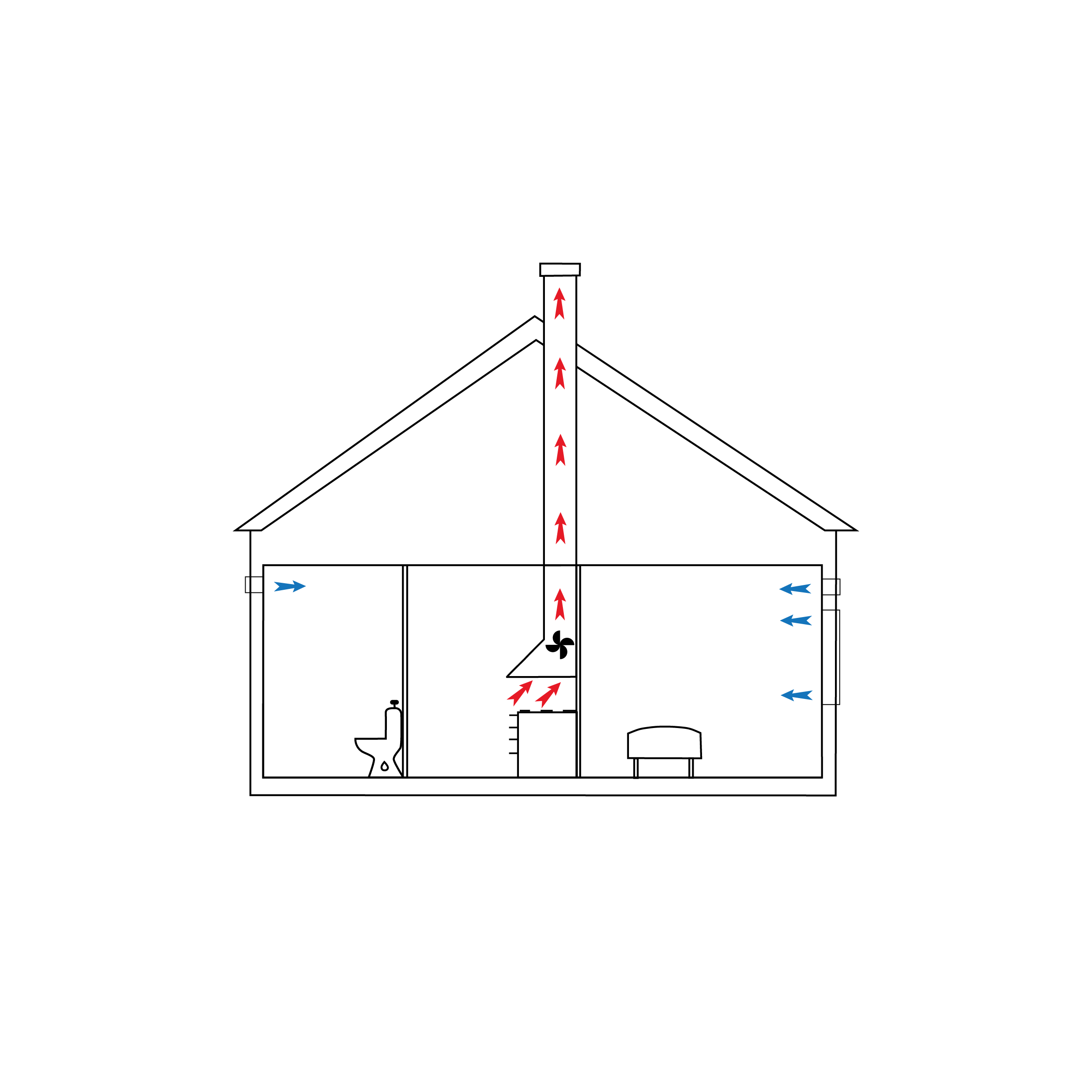
Duct-out
Where is the motor located? In the hood.
Where is the air directed? Out into the open air via the duct.
Where does the new air come from? Doors, windows, vents or unit.
Where is this common? Single-family homes and townhouses.
Other: This is the most common type of ventilation.
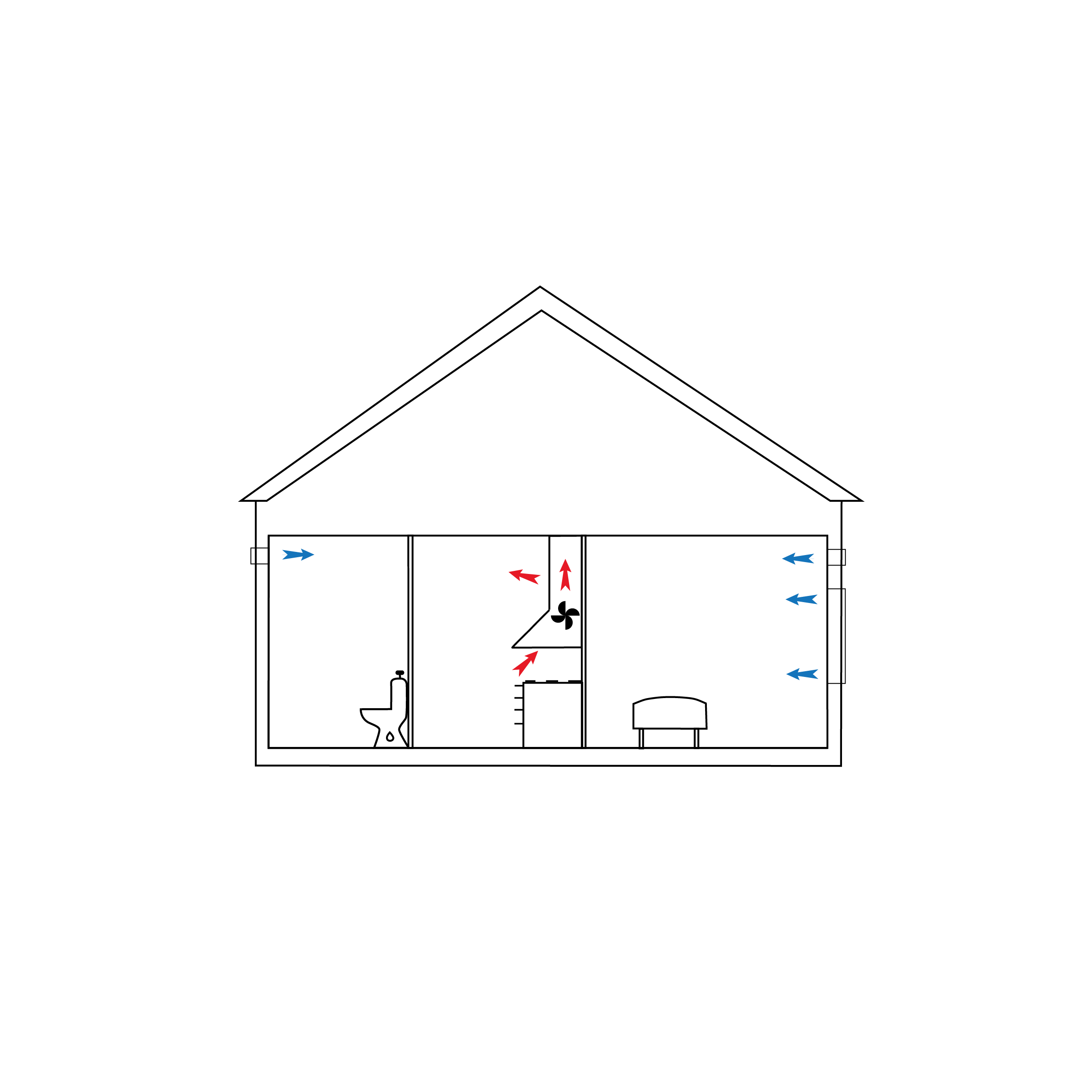
Recirculation
Where is the motor located? In the hood.
Where is the air directed? The air is cleaned via the carbon filter and returned to the kitchen via air slots at the top of the duct or other suitable locations.
Where does new air come from? Doors, windows and vents or the unit.
Where is this common? Apartments, dormitories or places where it is difficult to ventilate the air.
Other: The carbon filter must be changed regularly to ensure optimal function, often several times a year, depending on the filter type and use.

Are you unsure what type of ventilation you have in your home, or do you need a new carbon filter?
Send a request via our service form and our technical support will help with the rest.

LED lights
LED is an abbreviation for Light Emitting Diode, or in short, electrical energy that is converted into visible light. The difference from a regular light bulb is that in a traditional light bulb there is a metal wire that heats up and starts to glow (give light) when electricity is supplied. Most of the energy is used to make the bulb warm.
In an LED there is a small chip in a small reflector, between two electrical points. This chip starts to light when the electricity is switched on. A very small part of the energy is lost as heat, and an LED starts to light much faster than a bulb. What is so great about LED is that the bulbs/diodes have a lifespan of 50 times longer than a regular bulb. LED lights require very little power and are very resistant to shock and vibration.
Our Sense kitchen hoods with LED lighting have a comfortable brightness of approx. 4000 oK and an energy consumption of 3 W. You can also adjust the brightness of the light via the RørosHetta app.
By investing in a “green” RørosHetta hood (with brushless motor + LED light) instead of one with a “standard” motor + halogen light, you save the environment from an emission of 288 kg of CO₂ per year! If you compare this to driving a car, you save CO₂ equivalent to a mileage of 1,747 km per year, which is equivalent to the distance between Kristiansand and Trømsø!

Brushless motor
It is very important for all of us to reduce energy consumption. In the new brushless motor, which you will find in our RørosHetta Sense kitchen hoods, the worn carbon brushes have been completely removed.
The new technology provides a more stable motor operation, which in turn leads to a significantly lower noise level. In short, the rotor acts like a compass needle that tries to adjust itself to the constantly changing magnetic field. This is controlled by electronic systems that send “waves” of current around the coil. This can be compared to a football stadium, where the audience (the coils) “catch the wave”. The waves are reflected in a magnetic wave that the magnet rotates after.
A brushless motor guarantees significant energy savings combined with high recovery efficiency: -85% power consumption (kW/h) at medium-low speeds and -35% consumption (kW/h) at high speeds. A brushless motor has approximately twice the lifespan of conventional motors.

Energy consumption
A modern cooker hood is usually not a big energy guzzler, but there are exceptions.
An unnecessarily powerful motor will create a negative pressure in the room that needs to be replaced with air from outside. This replacement air needs to be heated to room temperature, which requires energy.
The important thing is to find the balance between effective ventilation and sensible energy consumption. All our cooker hoods with integrated Sense technology have lighting that uses 7 times less energy than incandescent lamps.
Look for the symbol on the right of the product pages here on our website or in our product catalogue to find the right Sense cooker hood for you.